Comparable reporting in the case of structural changes - Part 2: Practical example of the use of comparable metrics in business planning and control

In the June edition of our magazine we outlined the essential requirements and principles for professional comparable reporting; in the second part of our report below, we demonstrate, by means of a practical example, how companies can set up a control system with comparable metrics in the case of structural changes. The focus here is on a pragmatic, system-based approach that meaningfully combines automation supplemented by manual input and deliberately restricts itself to a few selected planning and control-specific metrics.
Practical example - Baseline situation and vision
An industrial company, which operates internationally, is realigning its medium-sized organisation and supplementing its existing structure with product-oriented and segment-based logic. The aim is to map out clearer market and profit responsibilities and to align planning and control more closely with products and customers.
However, it should be possible for the management to analyse the new segments not only in the future, but also retrospectively over several years. Key questions concern the trends in revenues, results, and cash flow in the new segments. To this end, the historical data has to be selectively reconciled.
Objective
For the company it is about having an additional planning and control perspective that provides historical comparability without changing the existing reporting logic. The original structure is retained as a reference while, at the same time, a new segment view is created.
System-based implementation
In the practical case that is being presented, the implementation of comparable reporting is supported by a system on the basis of CCH Tagetik, a financial platform that combines closing, planning and reporting - with expert AI that intelligently supports each process (a possible alternative would be, for example, Lucanet). The starting point is a structured comparison of the existing organisational units and the new product-oriented segments.
In the project, it was possible to derive a clear assignment to the new segments for a large proportion of the organisational units. In the system these assignments were defined on the basis of rules. On this basis, historical revenues, results, and cash flows can be automatically assigned to the new segment logic.
Supplementary classification and structured inputs
As in many comparable projects, the practical case study likewise demonstrates that not all situations can be automatically mapped clearly. It is moreover not always possible to assign, in particular, central functions, inter-divisional cost structures, or support units directly to a single segment.
In the specific project, a clearly defined supplementary process was set up, however, without using fully standardised allocation logic. Instead, the allocation took place directly in the system via digital input forms on the basis of existing profit centre structures and the professional assessments of the controllers. They were specifically involved and carried out some of the allocation manually on the basis of their detailed knowledge of business models and value chain inter-relationships. In this way, parts that could not be obviously assigned were able to be allocated comprehensibly and consistently to the new segments.
Focus on the planning and control-specific metrics
A key principle of implementation in an industrial company is the clear focus on planning and control-specific KPIs. The emphasis is particularly on revenues, segment results and free cash flow.
Not every metric will be made comparable retroactively. This deliberate prioritisation ensures that the manual workload remains proportionate to the benefits. This increases the level of acceptance in the management.
Integration of controlling and accounting
An adequate and effective comparable reporting approach does not end in the controlling department. In the practical case that was considered, the accounting department was also involved at an early stage because the new segments will have a direct impact on the financial reporting.
In particular, consistent opening balance sheets have to be created for the new organisational structure. These serve as the basis for the ongoing accounting (cf. Fig.1).
Fig. 1 Preparation of opening balance sheets as the basis for further analyses
Automated journal entries are based on ERP data with opening balance sheets in a new structure; at the same time, data consistency is ensured.
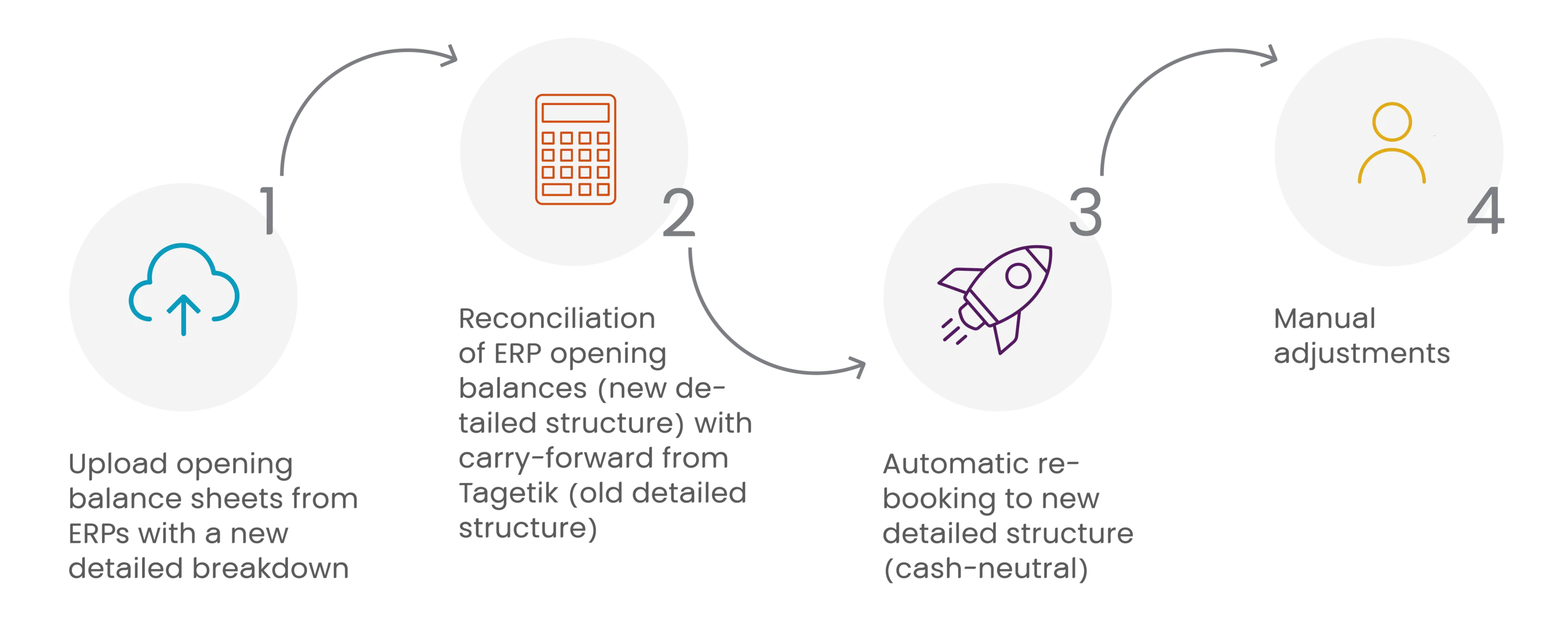
In the industrial company that is considered here, the implementation of this requirement was likewise supported by a system. The opening balance sheets were derived fully automatically from the legacy system data on the basis of a defined calculation logic and reconciled to the new segments. The underlying rules were defined once and then applied consistently. Subsequently, structured check reports were made available in order to identify any remaining inconsistencies and, if necessary, to make specific manual adjustments.
Consolidated view and use in reporting
Following the transfer of the historical data, the values for the new segments were consolidated once again. This results in a coherent overall view of the company that includes both the previous structure as well as the new one.
The benefits of this solution are particularly evident in day-to-day reporting. The management can carry out evaluations both in the traditional organisational logic as well as in the new segment structure. Time series analyses over the course of several years will be possible and will provide comparable conclusions regarding the performance of the individual segments. Differences between the old and new structures can be traced at any time here. As both views are available simultaneously in the system it is possible for causes to be transparently analysed and explained.
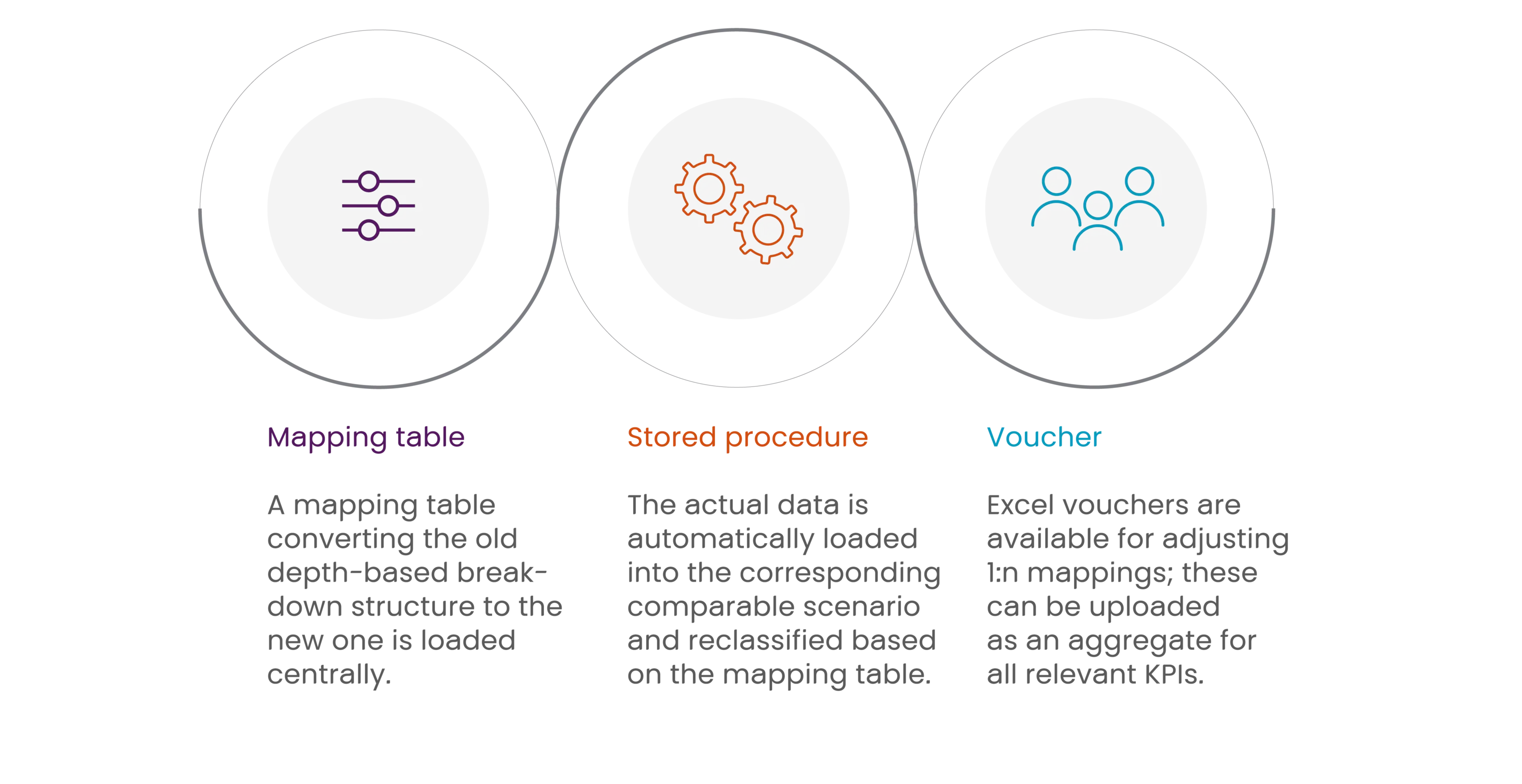
Another advantage is the ongoing usability of the solution. New periods can be shown in the new structure without any additional manual tasks. Even if further adjustments are made, the existing logic can still be used (cf. Fig.2).
Fig. 2 System-based implementation of comparable reporting
Comparable reporting is generated in three steps for 1:1 and 1:n mappings, in each case with the maximum possible level of automation
Transparency and comprehensibility
It is of key importance that all assumptions, rules and supplementary inputs defined in the project are documented and versioned at the system level. This creates a high degree of transparency about the underlying derivations.
Advantages realised in controlling and reporting
In the practical case study described above, the system-based solution plays a key role in meeting these requirements and, at the same time, enhancing reporting efficiency. The practical case study demonstrates that comparable reporting is not a theoretical concept, but rather that it can be implemented efficiently by using a clear methodological approach and appropriate system support.
The crucial factor is the interplay between professionally defined targets, intentional focus and technical implementation.