The double foundation - Tax-optimised transfers of assets and benefits (Part II: Tax structuring in a practical case study)
Double foundations can constitute an effective instrument for business succession and asset protection in the long term because they make it possible to combine the advantages of family foundations and public benefit foundations. In Part I of our report - in the last edition of our magazine - we discussed the fundamental principles of the double foundation and the main tax issues pertaining to its establishment. Here, in Part II, we delve into the tax-optimised structuring of the establishment of a double foundation on the basis of a practical case study with specific calculations; moreover, we consider the ongoing taxation from different perspectives.
1. Practical case study - Initial situation and the inheritance tax consequences without structuring
‘A’, the company owner, has had his assets appraised and their composition is shown in the following overview.
| Asset component | Fair market value |
|---|---|
| A GmbH (100% stake) | € 60m |
| Distribution: € 4m p.a. | |
| Properties rented out to third parties | € 8m |
| Equity portfolio | € 3m |
| Personal use property | € 2m |
If these assets are transferred to the company owner A’s two children by way of natural succession or allocated to them in equal measure, then a high tax burden would be incurred. For inheritance tax purposes, after applying the exemption under Section 13d of the Inheritance and Gift Tax Act (Erbschaft- und Schenkungsteuergesetz, ErbStG), the properties rented out to third parties would have to be included in the amount of € 3.6m per child. Moreover, no tax exemption would apply to the equity portfolio, which is why it would have to be included in the amount of € 1.5m per child.
The 50% stakes in A GmbH [German limited liability company] would each have to be valued at € 30m (50% of € 60m). For amounts above € 26m, the regular relief of 85% available under Section 13c ErbStG, decreases by 1% for every full € 750k. In the case of a 5% decrease, or remaining regular relief of 80%, a taxable portion of € 6m per child would remain.
The taxable devolution of assets adds up to € 11.1m per child. Therefore, after deducting the tax-free allowance of € 0.4m in each case, this gives rise to a taxable acquisition of € 10.7m per child. The resulting inheritance tax adds up to about € 2.46m per child, which corresponds to an overall burden of about € 4.92m.
2. Structuring with the double foundation
‘A’ was truly blown away by such high burdens and would like to transfer his assets to a tax-optimised double foundation. The goal is to provide financial security for himself as well as for his children and, furthermore, for his assets and large portions of the future profits to be used for public benefit purposes and to do much good. ‘A’ opts for the structure shown in the following figure.
Structure of the double foundation
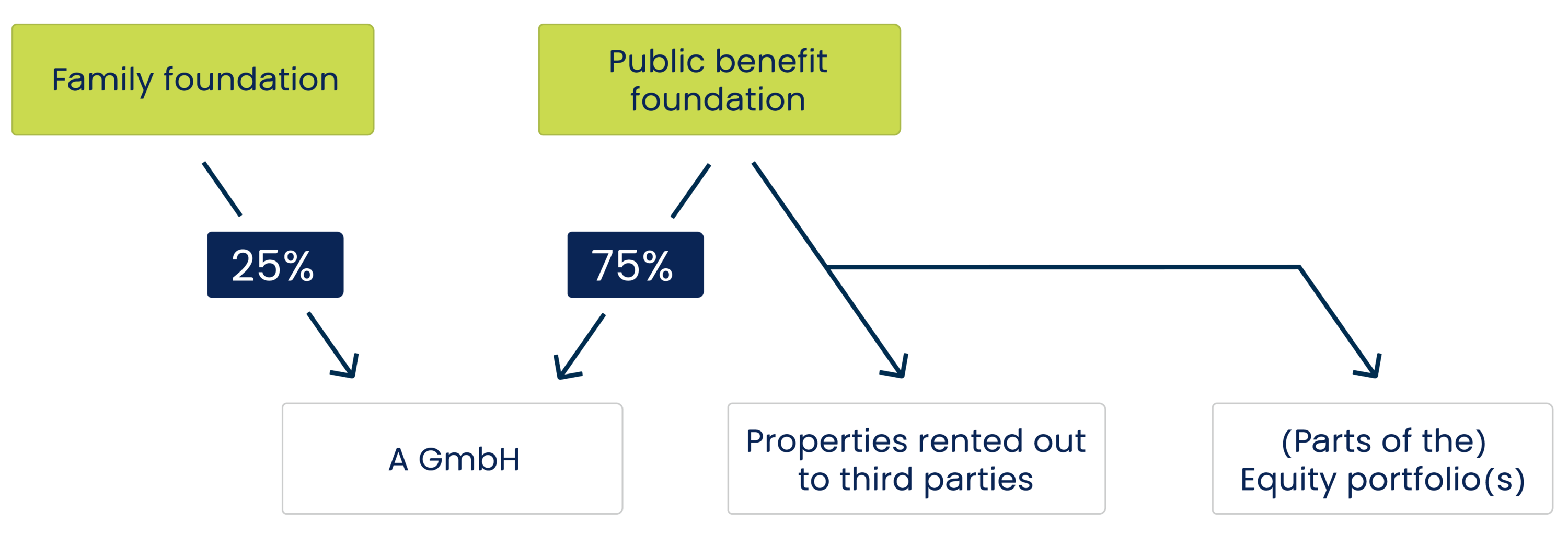
- A minimum stake of 25% in A GmbH is transferred to the family foundation in order to make use of the inheritance tax breaks for business assets. ‘A’ believes that 25% of the annual distribution by A GmbH should be enough to provide for him and his children.
- The remaining 75% of the shares in A GmbH is transferred to the public benefit foundation.
- There is a maximum possible exemption of 10% for properties rented out to third parties, under Section 13d ErbStG, when these are transferred to a family foundation. Therefore, to ensure the lowest possible tax burden, the properties rented out to third parties are transferred to a public benefit foundation.
- A tax-exempt transfer of the equity portfolio to the public benefit foundation takes place in accordance with Section 13(1) no. 16(b) ErbStG. A partial transfer to A’s children would also be a possible alternative in order to optimally exploit the inheritance tax exemptions every 10 years.
- The personal use property will only be transferred to members of the family upon A’s death so that it will be possible to claim the tax exemption for family homes under Section 13(1) nos. 4a, 4b and 4c ErbStG.
3. The calculation of the tax charges arising from the establishment of a double foundation
Public benefit foundation
Public benefit foundation - The transfer to the public benefit foundation of 75% of the shares in A GmbH, the properties rented out to third parties and (a part) of the equity portfolio is exempt from inheritance tax.
Family foundation
Family foundation - As regards the transfer of a 25% stake in A GmbH to the family foundation, the tax exemption under Sections 13a, 13b ErbStG is applicable. The pro rata fair market value of A GmbH amounts to €15m (25% of € 60m). Applying regular relief of 85% produces taxable assets in the amount of € 2.25m. After deducting the tax-free allowance (€ 0.4m, tax class privilege, applicable here just 1x) the taxable acquisition for the transfer to the family foundation amounts to € 1.85m. Ultimately, the entire process of transferring assets to the family foundation and the public benefit foundation incurs inheritance tax in the amount of € 0.35m.
4. Ongoing taxation of a double foundation and its beneficiaries
4.1 Ongoing taxation of a family foundation
The income of a family foundation is subject to corporation tax (15% for assessment periods until 2027, plus the solidarity surcharge). However, for a family foundation, distributions from, at least, a 10% stake in a corporation are 95% tax-exempt. The distribution is subject to a charge that results from capital gains tax and the solidarity surcharge in the amount of 26.375%; however, this can be credited against the foundation’s corporation tax.
The family foundation is liable for trade tax if it runs a commercial business operation. Simply holding the stake constitutes an asset management activity and does not establish a commercial business operation. Income from a foundation’s stake in a corporation does not trigger trade tax. The same applies to income from the letting of property and income from an equity portfolio that accrues to a family foundation. This means that in the case of a gross profit distribution by A GmbH in the amount of € 1m, for the family foundation only 5% or € 50k would be subject to corporation tax. Consequently, at the level of the family foundation, the effective rate of tax due to the profit distribution would be almost 0.8% or an amount of € 8k.
4.2 A particularity - Substitute inheritance tax for family foundations
In the case of family foundations, the so-called substitute inheritance tax constitutes a particularity. The transfer of assets to a family foundation removes the transferred assets from the intergenerational system whereby inheritance tax is imposed. That is why, in 1974 already, German legislators introduced substitute inheritance tax for family foundations. Accordingly, every 30 years, a family foundation’s assets are subjected to inheritance tax.
For the purposes of substitute inheritance tax, there would be a simulation whereby all the family foundation’s assets existing on the tax assessment date would be bequeathed to the testator’s two children. The tax exemption provisions under the ErbStG and the needs assessment are likewise applicable in the case of substitute inheritance tax.
4.3 Ongoing taxation of the public benefit foundation
The income of public benefit foundations is generally exempt from tax. Consequently, the income that the public benefit foundation of ‘A’, the company owner, generates
- from the letting of properties,
- from the profit distributions by A GmbH of €3m p.a., and
- from dividends from the equity portfolio
are subject to neither corporation tax nor trade tax.
4.4 Ongoing taxation of beneficiaries
Ongoing allocations by a family foundation constitute income from capital assets for the beneficiaries and are generally subject to capital gains tax plus the solidarity surcharge in the amount of 26.375%. If the family foundation pays out A GmbH’s annual dividend of €1m after deducting the tax charge of €8k, then €730k p.a. will remain to provide for A and his two children.
Allocations by public benefit foundations to beneficiaries are admittedly exempted from tax insofar as such allocations are consistent with the purposes in the statutes of the foundations. However, such allocations to the founder themself and their beneficiaries are only possible in exceptional cases and with due regard to the tight limits under Sections 51 ff. of the German Fiscal Code (cf. Part I of this report in issue 10/2026).